When choosing an aroma diffuser for commercial or branded use, the initial unit price is only part of the equation.
For B2B buyers, product managers, and procurement teams, the real question is:
Which diffuser offers a lower Total Cost of Ownership (TCO) over its full lifecycle?
In this article, we provide a technical and financial breakdown of the maintenance requirements, spare parts, and long-term operating costs of nebulizing diffusers vs. ultrasonic diffusers, based on real-world manufacturing and export experience from China.
As a nebulizing diffuser supplier in China offering OEM and ODM services, we aim to help international buyers make data-driven sourcing decisions, not just marketing-driven ones.
What Is TCO in B2B Diffuser Procurement?
Total Cost of Ownership (TCO) includes all costs incurred throughout a product’s lifecycle:
-
Initial purchase cost
-
Replacement parts & consumables
-
Maintenance & servicing
-
Downtime or failure-related costs
-
Product lifespan before replacement
For hospitality, wellness brands, and private-label programs, TCO matters more than unit price.
Component-Level Comparison: Nebulizing vs Ultrasonic Diffusers
Ultrasonic Diffusers: High Wear, Frequent Replacement
Ultrasonic aroma diffusers rely on high-frequency vibration of a ceramic piezoelectric plate in water.
Key cost drivers:
-
Ultrasonic atomizing plate (wear-prone)
-
Water tank contamination and scaling
-
Electronics exposure to moisture
-
Fan-assisted mist outlet blockages
Typical issues over time:
-
Atomizing plate degradation (3–12 months in commercial use)
-
Reduced mist output
-
Increased failure rate in high-humidity environments
 Nebulizing Diffusers: Fewer Consumables, Longer Lifespan
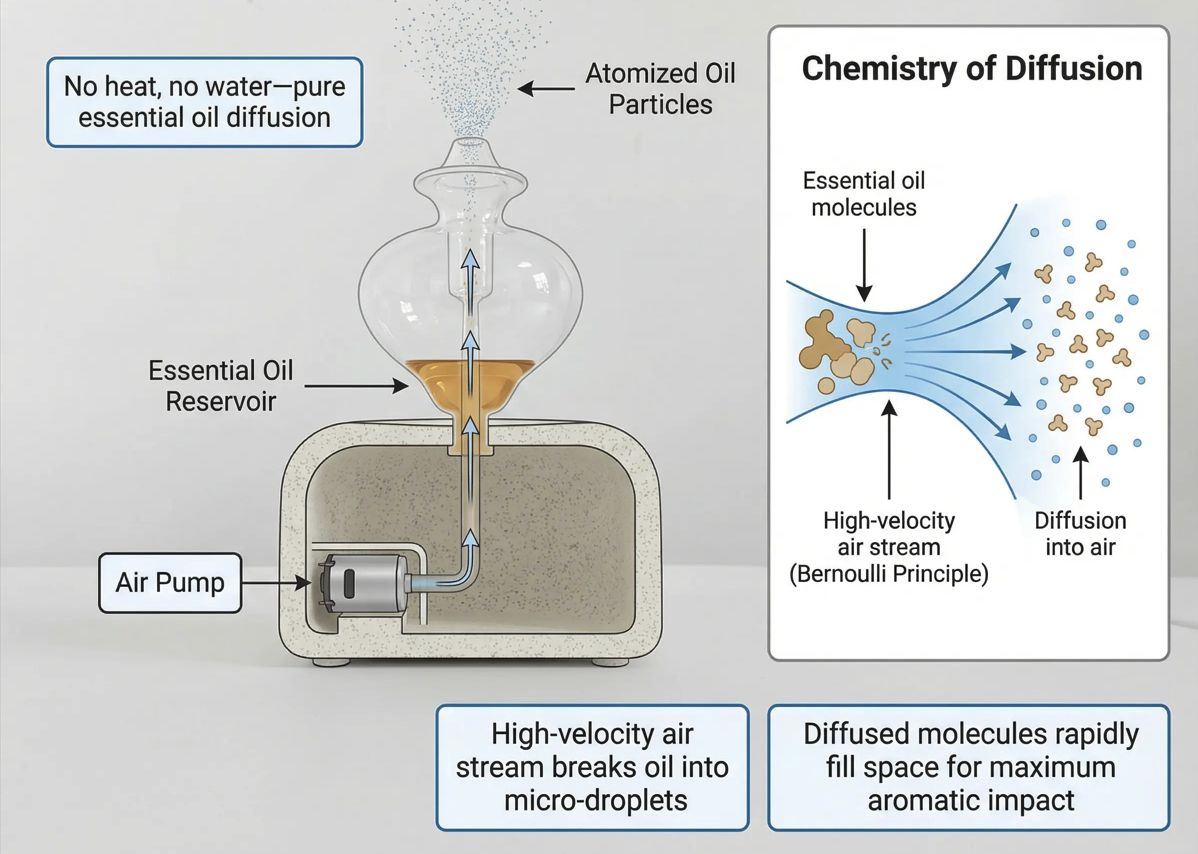
Nebulizing diffusers use cold-air atomization to disperse pure essential oils without water or heat.
Core components:
-
Precision glass nozzle
-
Oil-resistant air pump
-
Sealed airflow chamber
Advantages for long-term use:
-
No atomizing plate
-
No water scaling or bacterial buildup
-
Minimal electronics exposure to liquids
-
Parts are modular and serviceable
For glass & wood or glass & concrete nebulizing diffusers, maintenance is primarily mechanical rather than consumable.
Maintenance Cost Comparison (3-Year Commercial Use)
| Cost Factor | Ultrasonic Diffuser | Nebulizing Diffuser |
|---|---|---|
| Atomizing component | Frequent replacement | Not required |
| Water tank cleaning | Weekly | Not required |
| Failure rate | Medium–High | Low |
| Average lifespan | 1–2 years | 3–5 years |
| Maintenance skill | Low | Low–Medium |
| Downtime risk | High | Low |
From a TCO perspective, nebulizing diffusers consistently outperform ultrasonic models in medium to long-term deployment.
Spare Parts & After-Sales Support: A Manufacturer Perspective
As a diffuser manufacturer in China, we see a clear difference in after-sales patterns:
-
Ultrasonic diffusers generate high after-sales volume due to part wear
-
Nebulizing diffusers require fewer but higher-quality components
-
OEM clients prefer serviceable glass components over disposable electronics
This is especially important for:
-
Hotel scenting programs
-
Wellness chains
-
Private-label aromatherapy brands
Lifecycle Cost: Why Nebulizing Diffusers Win in B2B
While nebulizing diffusers may have a higher initial unit price, their lifecycle economics are superior:
-
Lower replacement frequency
-
Reduced maintenance labor
-
Higher scent efficiency per ml of oil
-
Better brand perception for premium positioning
This makes nebulizing diffusers ideal for:
-
Long-term installations
-
Premium essential oil brands
- Sustainability-focused buyers
👉Learn more: How Nebulizing Diffusers Work vs. Ultrasonic Diffusers
OEM & ODM Considerations When Sourcing from China
If you are evaluating how to find a good nebulizing diffuser factory in China, TCO should be part of your RFQ checklist:
-
Are replacement parts standardized?
-
Can glass components be customized?
-
Is after-sales support available internationally?
-
Are pumps and seals oil-grade certified?
👉 Recommended read:
How to Find a Good Nebulizing Diffuser Factory in China
Conclusion: Which Diffuser Makes More Financial Sense?
For short-term, low-cost consumer use:
Ultrasonic diffusers may appear attractive.
For premium brands, the B2B buyers focused on reliability, branding, and lifecycle cost:
Nebulizing diffusers deliver lower TCO, higher durability, and better scent performance.
As a nebulizing diffuser OEM & ODM supplier in China, we help global brands design solutions optimized not just for price—but for long-term business performance.